The Untamed Character Names: Hidden Meanings
How the Naming System Works
Understanding The Untamed character names becomes much easier once the basic naming system is clear. Characters may have personal names, courtesy names, titles, and other forms of address. More importantly, each form can reveal something different about age, status, intimacy, and social relationships.
Personal Names and Courtesy Names
Chinese names place the family name first. For example, in Wei Ying, Wei is the surname and Ying is the personal name. Similarly, in Lan Zhan, Lan is the surname and Zhan is the personal name. A character’s clan affiliation may align with the surname, although adoption, maternal lineage, illegitimacy, and political recognition complicate that connection throughout the drama.
A courtesy name, or zi, serves a different purpose. Traditionally associated with adulthood and social life, it provides a more formal way of addressing someone. Wei Wuxian and Lan Wangji are courtesy-name forms. Therefore, courtesy names allow respectful address among peers without the intimacy or presumption of using a personal name.
This distinction matters dramatically even when English subtitles do not explain it. For instance, choosing between “Lan Zhan” and “Lan Wangji” can reveal much more than simply which name a speaker prefers. The choice may signal familiarity, respect, emotional closeness, or deliberate disregard for normal social distance.
Titles, Kinship, and Forms of Address
Titles add another layer to the naming system. Hanguang-jun, Yiling Laozu, Zewu-jun, Chifeng-zun, and Lianfang-zun describe public identity, honor, reputation, or cultivated status. In other words, a title may reveal how society sees a person rather than how that person understands himself.
For example, “Yiling Patriarch” carries fear and political myth, whereas “Hanguang-jun” carries admiration and moral light. As a result, titles can become powerful public identities that sometimes overshadow the individuals behind them.
Kinship and affectionate forms create yet another layer. The prefix “A-” before one syllable can express familiarity, as in A-Yuan. Meanwhile, terms such as shijie, shixiong, and da-ge describe relational roles rather than legal names. These forms of address show who belongs to the same learning lineage, who is senior, and who is emotionally treated as family.
Why the Form of Address Matters
The most revealing question is therefore not simply, “What is this character’s name?” Instead, it is often more useful to ask, “Who uses which name, and when?”
A shift from a title to a courtesy name can reduce emotional distance. Likewise, a personal name may express childhood closeness, urgency, deliberate disrespect, or profound intimacy depending on the speaker and situation. Consequently, changes in forms of address can quietly reveal developments in a relationship without requiring explicit dialogue.
The naming system also supports the drama’s larger concern with public judgment. Characters gain titles through deeds, reputation, and rumor, yet their private names preserve identities formed before fame or disgrace. Ultimately, the difference between a person and the name society gives him becomes one of the story’s central tensions.
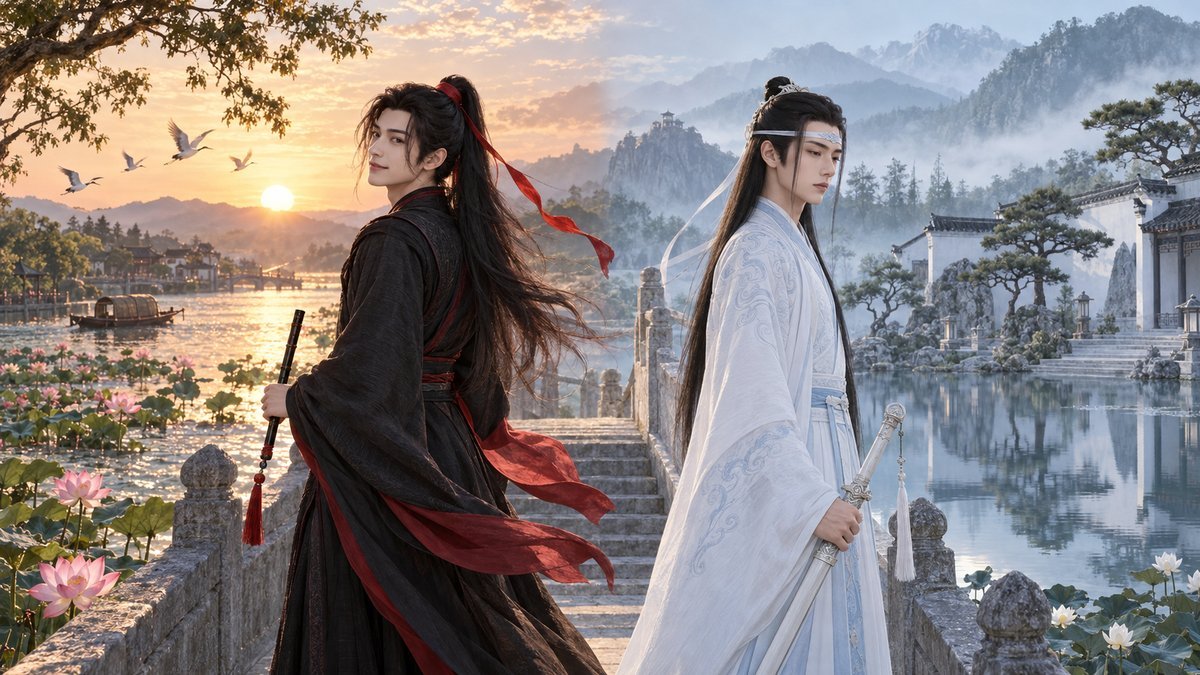
Wei Ying / Wei Wuxian and Lan Zhan / Lan Wangji
Wei Ying (魏婴) and Wei Wuxian (魏无羡)
Wei Wuxian’s personal name is Wei Ying. The character 婴 can mean an infant or young child. Readers sometimes connect that meaning with his orphaned childhood, emotional openness, playfulness, and ability to retain curiosity despite suffering. The association is suggestive rather than a complete character definition.
His courtesy name, Wuxian, is written 无羡. Wu means without or lacking; xian can mean envy, admiration, or coveting. “Without envy” is the most familiar rendering. It suits a character who values freedom more than rank and who rarely resents others for possessing status he lacks.
The name gains irony because the cultivation world envies and covets his power. Wei Wuxian may live “without envy,” yet others desire his inventions, resent his independence, and fear what they cannot control. His name describes an inner freedom that society punishes.
Yiling Laozu, commonly translated as the Yiling Patriarch, is a title built by public history. It enlarges Wei Wuxian into a frightening political figure. “Wei Ying,” by contrast, recalls the person known before that legend. Lan Wangji’s use of the personal name cuts through the title and recognizes the individual.
The Wei Wuxian Character Study explores how humor, independence, secrecy, and compassion make “without envy” feel especially appropriate.
Lan Zhan (蓝湛) and Lan Wangji (蓝忘机)
Lan Wangji’s personal name is Lan Zhan. Lan, 蓝, means blue and identifies the Gusu Lan family. Zhan, 湛, can suggest depth, clarity, or stillness, especially in relation to clear deep water. Those associations match his quiet surface and the emotional depth concealed beneath it.
Wangji is written 忘机. Literally, the characters combine “forget” with a word that can refer to mechanism, calculation, opportunity, or worldly scheming. In literary and philosophical usage, wangji suggests releasing calculated motives and forgetting worldly stratagems. The name evokes uncontrived sincerity rather than simple forgetfulness.
This meaning suits Lan Wangji’s development. He begins within a rule-bound environment but gradually distinguishes moral principle from social calculation. He is not skilled at political performance because he does not want relationships governed by advantage. His loyalty becomes powerful precisely because it is not transactional.
Hanguang-jun, 含光君, is often rendered “Light-Bearing Lord.” The characters suggest containing or holding light. The title describes virtue kept within: brightness without noisy display. It complements the stillness of Zhan and the uncalculated quality of Wangji.
Wei Wuxian’s early habit of calling him “Lan Zhan” ignores normal social distance. It is comic, provocative, and intimate. Later, the same form of address carries accumulated trust. For more on that change, see Lan Wangji Character Analysis.
Jiang and Wen Names — Water, Clarity, Warmth, and Separation
Jiang Cheng (江澄) / Jiang Wanyin (江晚吟)
The surname Jiang, 江, means river, making it visually fitting for a family rooted in the waterways of Yunmeng. Cheng, 澄, means clear, settled, or purified, often describing water after sediment has fallen. The name suggests clarity achieved through stillness.
Jiang Cheng’s emotional life rarely feels settled. He carries pride, grief, anger, duty, and love that cannot easily coexist. That tension makes the name poignant: clarity is both an ideal and something repeatedly disturbed.
His courtesy name Wanyin, 晚吟, can be read as “evening chant” or “late recitation.” It has a quieter, more lyrical feeling than his sharp public presence. The name hints at reflection after daylight, when action gives way to memory and words left unsaid.
Jiang Yanli (江厌离)
Yanli, 厌离, is difficult to compress into one smooth English phrase. Yan can mean weariness, aversion, or renunciation; li means separation, departure, or distance. The combination can suggest turning away from separation or becoming weary of a world defined by leaving.
Because Jiang Yanli repeatedly creates family connection through food, patience, and welcome, the name feels painfully relevant. She resists division even as political violence tears her family apart. The meaning should not be treated as a fixed prophecy, but its emotional vocabulary intensifies her story.
Wen Qing (温情) and Wen Ning (温宁)
The surname Wen, 温, means warm or mild. Wen Qing’s full name, 温情, is also an ordinary expression meaning warmth, tenderness, or humane feeling. The apparent softness contrasts with her controlled manner and medical precision, but it describes the compassion guiding her difficult choices.
Wen Ning combines warmth with 宁, a character associated with peace, calm, or tranquility. His gentle nature makes the name direct, while his violent treatment and transformation make it tragic. A person named for peace is repeatedly denied peace by the world around him.
These names show why literal meaning works best as resonance rather than destiny. Jiang Cheng can be named for clarity and remain conflicted. Wen Qing can embody warmth without appearing outwardly soft. Wen Ning can carry peace inside a body used for violence.
Lan Names — Light, Memory, and Proper Bearing
Lan Huan (蓝涣) / Lan Xichen (蓝曦臣)
Lan Xichen’s personal name is Huan, 涣, which can suggest dispersing, flowing outward, or the breaking apart of what was concentrated. The character has associations with water opening or spreading. That movement contrasts with the still depth suggested by his younger brother’s Zhan.
Xichen is written 曦臣. Xi, 曦, refers to sunlight, especially the light of dawn. Chen, 臣, means minister, subject, or one who serves. The courtesy name can therefore evoke a servant or minister of dawn light—an elegant image for a clan leader known for grace, mediation, and luminous public conduct.
The name also contains vulnerability. Dawn light allows people to see, but Lan Xichen’s trust does not always give him accurate knowledge. His desire to bring clarity and harmony cannot prevent carefully managed deception.
Lan Yuan (蓝愿) / Lan Sizhui (蓝思追)
Sizhui’s personal name in the Lan family is Yuan, 愿, meaning a wish, hope, or vow. The name feels like a blessing: survival is transformed into the possibility of a future rather than reduced to the violence of the past.
His courtesy name Sizhui is written 思追. Si means to think of, remember, or long for; zhui means to pursue, follow, or seek. Together, the name suggests remembering and pursuing—memory turned toward action.
That combination suits a young man who carries a lost history without becoming trapped by hatred. Sizhui seeks truth with gentleness. His name connects remembrance to ethical continuity rather than revenge.
Lan Jingyi (蓝景仪)
Jingyi, 景仪, suggests admirable bearing, dignified appearance, or exemplary manners. Jing can relate to brightness, grandeur, or what is worthy of admiration; yi refers to bearing, ritual form, or proper conduct.
The name creates affectionate comedy because Lan Jingyi is unusually outspoken for a Lan disciple. He belongs to a clan famous for controlled behavior, yet he complains, reacts, and says what others leave polite. The contrast does not make the name false. His loyalty and courage ultimately reveal an admirable bearing of their own.
Jin and Nie Names — Status, Preciousness, and Hidden Intention
Meng Yao (孟瑶) / Jin Guangyao (金光瑶)
Yao, 瑶, means precious jade or beautiful gem. The character gives Meng Yao a name of value long before society treats him as valuable. His intelligence, memory, discipline, and social perception are exceptional, but illegitimate birth determines how others receive those qualities.
When he becomes Jin Guangyao, the surname changes to Jin, 金, meaning gold and marking recognition by the powerful Lanling Jin family. Guang, 光, means light or radiance and belongs to the family’s generational naming pattern. “Radiant jade” sounds brilliant and precious.
The change is both achievement and warning. A new name grants status but does not erase humiliation. Jin Guangyao becomes extraordinarily skilled at producing the polished identity the name demands. The gem shines because it has learned exactly how others judge its surface.
Jin Ling (金凌) / Jin Rulan (金如兰)
Ling, 凌, can suggest rising, crossing, soaring, or pressing beyond. The character has upward and forceful energy that suits Jin Ling’s sharp temper, pride, and determination to establish himself despite grief.
His courtesy name Rulan, 如兰, means “like an orchid.” The orchid traditionally evokes refined character and cultivated virtue. The name imagines grace beneath the defensive thorns of his personality.
Rulan also preserves a naming bond with Wei Wuxian, who participates in choosing it before Jin Ling’s birth. The courtesy name quietly links the young man to an uncle he was taught to hate. Naming holds a relationship that public family history attempts to erase.
Nie Huaisang (聂怀桑)
Huaisang is written 怀桑. Huai can mean to hold, cherish, remember, or harbor; sang means mulberry. Mulberry imagery can evoke cultivated domestic life, homeland, and the quiet routines of settlement. The combination has a soft, reflective quality.
That softness fits the persona Nie Huaisang presents: a man interested in fans, art, comfort, and avoidance rather than saber discipline or political confrontation. Yet “to harbor” also offers another resonance. He holds knowledge, grief, and intention for years while appearing incapable of decisive action.
This reading should remain interpretive, but the effect is compelling. A name associated with cherishing something ordinary belongs to a character whose modest surface conceals a formidable long memory.
Yi City Names — Dawn, Mist, Beauty, and Irony
Xiao Xingchen (晓星尘)
Xingchen, 星尘, means “star dust,” while Xiao, 晓, can mean dawn, daybreak, or understanding. Together the name creates an image of light at the edge of night: celestial, pure, beautiful, and difficult to hold.
The name suits a wandering cultivator defined by idealism and moral aspiration. It also anticipates fragility without reducing his fate to prediction. Stardust is luminous but scattered; dawn reveals truth, yet Xiao Xingchen is deprived of sight and manipulated through incomplete knowledge.
Song Lan (宋岚) / Song Zichen (宋子琛)
Lan, 岚, means mountain mist. It suggests distance, wandering, cool air, and a form that can be seen without being grasped. Those associations complement Song Lan’s disciplined reserve and the long separations in his story.
His courtesy name Zichen, 子琛, uses 琛, meaning treasure or precious object, with 子 as a respectful or classical personal element. The name brings value and dignity to a character who endures dehumanization but retains a connection to loyalty and purpose.
Xue Yang (薛洋) / Xue Chengmei (薛成美)
Yang, 洋, commonly suggests the ocean, vast water, or expansiveness. That breadth contrasts with a life shaped by one small childhood injury and the resentment that grows around it. The scale of the character and the scale of the wound refuse to match.
His courtesy name Chengmei, 成美, means completing beauty or bringing the good to completion. It echoes the classical idea that a morally cultivated person helps others complete what is good rather than what is harmful.
The irony is severe. Xue Yang has the intelligence and skill to create, repair, and understand, yet he uses those abilities to manipulate and destroy. “Completing beauty” becomes the name of someone who repeatedly prevents others from completing a good life.
The Yi City names share a poetic vocabulary—dawn, stars, dust, mist, treasure, vast water, and beauty. Their elegance intensifies the tragedy because names preserve ideals that events violate. The characters do not simply fulfill their names; they struggle with the possibilities those names contain.
Frequently Asked Questions
Why does each character have multiple names?
Many characters have a family name, personal name, courtesy name, and title. The form used depends on age, formality, intimacy, hierarchy, and public reputation. Kinship terms and affectionate prefixes create additional ways of addressing someone.
Why does Wei Wuxian call Lan Wangji “Lan Zhan”?
Lan Zhan is Lan Wangji’s personal name. Using it casually when they first meet ignores normal formality and shows Wei Wuxian’s boldness. Over time, the address becomes a sign of unusual closeness and recognition.
Are courtesy names the same as titles?
No. A courtesy name is a formal adult name, such as Wuxian or Wangji. A title reflects public status or reputation, such as Yiling Laozu or Hanguang-jun. The same person can possess both.
What does Wuxian mean?
Wuxian, 无羡, is commonly translated as “without envy” or “without coveting.” It suggests freedom from comparison and desire for another person’s status, fitting Wei Wuxian’s independent nature.
What does Wangji mean?
Wangji, 忘机, suggests forgetting worldly schemes, calculations, or contrived motives. In literary usage it evokes an uncalculating state of mind rather than ordinary forgetfulness.
What does Sizhui mean?
Sizhui, 思追, combines remembering or thinking of someone with pursuing or following. The name can suggest carrying memory forward through action, which fits his compassionate search for truth.
Are all name meanings intentional foreshadowing?
Not necessarily. Chinese characters support several translations and cultural associations. Some names clearly reinforce characterization or irony, while other readings are interpretive. The safest approach is to treat meaning as an added resonance rather than a code that mechanically predicts plot.
Conclusion
The Untamed character names create layers of identity. Personal names hold childhood, vulnerability, and intimacy. Courtesy names present cultivated adults to the social world. Titles preserve achievement, fear, honor, or political myth. The name a speaker chooses tells us what relationship is possible in that moment.
The meanings deepen those layers without locking characters into definitions. Wei Wuxian lives without envy while others covet his power. Lan Wangji releases worldly calculation while learning to act from conscience. Sizhui turns memory into pursuit. Chengmei turns “completing beauty” into moral irony. Rulan preserves an orchid-like hope inside a wounded family history.
To name someone accurately is one form of recognition. The drama asks whether its characters will be remembered by feared titles, polished public identities, or the private names spoken by people who truly knew them. If you enjoy detailed readings like this, you can support more essays through Ko-fi.
Fan-Favorite Collectibles & Gifts